
The proposed ordinance on food security is likely to be taken up again at a meeting of the Union Cabinet on Wednesday, when it will consider whether to go ahead with promulgating it or convene a special session of Parliament for its passage.

A bench comprising justices T S Thakur and Vikramajit Sen declined to hear the plea and asked the petitioner to approach the high court for redressal of his grievances.

The Congress government in Assam hopes to implement the National Food Security Ordinance which has been passed by the Congress-led United Progressive Alliance government in the Centre, within six months, as desired by the Centre.

A public interest litigation was filed on Saturday in the Supreme Court seeking quashing of controversial Food Security Ordinance on the ground that the constitutional provision has been misused for pre-election propaganda and political gains.

The recently promulgated National Food Security Ordinance might breach the global trading rules on agriculture under the World Trade Organization if there is diversion of the subsidised foodgrain for export.

President Pranab Mukherjee signed the ordinance on food security to give nation's two-third population the right to get 5 kgs of foodgrains every month at highly subsidised rates of Rs 1-3 per kg.

Nowhere on the planet, nowhere in mankind's history has such an idea taken the concrete shape in form of a law. The National Food Security Bill, which will come via ordinance and not after the debate in Parliament, is an incredible economic tool to tackle the hunger of poor Indians. Also, it has already been condemned widely as a political gimmick.

Dismissing the talk about early elections, the Congress said the food security measure is a game changer that will provide right to cheap food grains to 82 crore people.
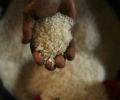
The ordinance on the Food Security Bill is expected to come up for consideration in the Lok Sabha on Wednesday, sources said on Monday.

The government on Thursday sent the ordinance on food security to President Pranab Mukherjee for his consent.

The government today decided to promulgate an ordinance to give nation's two-third population the right to 5 kgs of foodgrain every month at highly subsidised rates of Rs 1-3 per kg. The Cabinet, which had in June deferred a decision on the issue, today approved promulgating an ordinance to implement the Food Security Bill, sources said.

Attacking Prime Minister Manmohan Singh over the proposed Food Security Bill, Gujarat Chief Minister Narendra Modi said the bill, in its current form, will push the country toward "malnutrition".

The Congress on Saturday rubbished media reports that it is going to use the Food Security ordinance as a trump card in the 2014 Lok Sabha polls, saying the United Progressive Alliance government at the Centre has come up with various schemes in the social sector and for the nation's welfare during its nine-year rule.
The much-touted Food Security Bill, which proposes to give the country's three-fourth population the right to highly-subsidised food, was introduced in the Lok Sabha on Wednesday, with the government rejecting apprehensions that it would impinge upon the rights of states.
.jpg)
Sakshi Balani presents an FAQ on the Food Security Bill that was passed by Lok Sabha on Tuesday.

Critical of the hurried clearance of the food security ordinance, Bharatiya Janata Party President Rajnath Singh said on Thursday the United Progressive Alliance government was just doing a "political gimmick in a hurry" before the 2014 general elections.
While the Delhi and Haryana governments have declared that they are all set to roll-out the food security programme on August 20 -- Rajiv Gandhi's birth anniversary -- there is confusion among the chief ministers about the implementation of the ordinance which gives the right to people to receive adequate quantity of food grains at affordable prices. Anita Katyal reports.

A day before the Cabinet considers issuing an ordinance to implement government's ambitious National Food Security Bill, Food Minister K V Thomas said all UPA allies, including Nationalist Congress Party, are on board and there was a consensus on issuing an ordinance.

Ushering in the biggest programme in the world to fight hunger, Parliament on Monday gave its nod to the landmark Food Security Bill which seeks to provide highly subsidised foodgrains to the country's two-third population as a right.

After much delay and uncertainty, the landmark Food Security Bill was passed by the Lok Sabha on Monday which seeks to provide cheap foodgrains to 82 crore people in the country, ushering in the biggest programme in the world to fight hunger.

Terming the Bill as a 'non political bipartisan issue,' he hoped to have all political parties on board as the Bill would benefit over 75 per cent of rural households and 50 per cent of urban households in the country.
The Congress is planning a high-pitch media blitzkrieg in the run up to the assembly and general elections on the twin agenda of governance and development as opposed to the Bharatiya Janata Party's decision to push for Hindutva.

Nationalist Congress Party Supremo and Agriculture Minister Sharad Pawar has dismissed the possibility of early general elections in view of government issuing food security ordinance, saying the "question does not arise unless and until the food reaches the people".

'Poverty eradication is a continuous process. There is no full stop to it.'

Food bill, which is dubbed as the world's largest social welfare programme, aims to give legal right over an uniform quantity of 5 kg foodgrains at a fixed price of Rs 1-3 per kg via ration shops to 67 per cent of the population.

Implementing the Food Ordinance is the bigger challenge and there are many provisions of the National Food Security Bill which need to be expanded and strengthened.
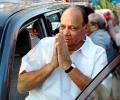
The bill, considered by many in the Congress as a gamechanger which could boost its prospects in the Lok Sabha election, was tabled in the Budget Session but could not be taken up for discussion as Opposition stalled Parliament over a rash of scams under United Progressive Alliance.
The government's move to issue an ordinance to implement the Food Security Bill saw major opposition parties stepping up their attack on the United Progressive Alliance accusing it of bypassing Parliament and acting in a hurry with an eye on polls.

Congress senior leaders concede that UPA could be safe in terms of numbers but that does not solve problem totally

Making it clear that he was not opposed to the National Food Security Bill, Union Agriculture Minister Sharad Pawar on Friday said he would prefer it to be approved by Parliament after a debate.

The Congress will only be able to gain from the bill if its benefits percolate down to the people within the next eight months, says Anita Katyal
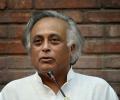
The United Progressive Alliance's growth story' and food security scheme dominated a Congress workshop on Monday where its media managers from across the country were given training to disseminate party's message on key issues ahead of next Lok Sabha polls.
Might discuss Ordinance route tomorrow, note circulated among ministers listing discussion topics.
Samajwadi Party chief Mulayam Singh Yadav attacked the Congress over the food security ordinance, accusing it of indulging in vote bank politics and said its intentions were not good.
.jpg)
According to an internal assessment of the food ministry, shared with chief ministers recently, Tamil Nadu, Kerala, Jammu & Kashmir and Himachal Pradesh will see a massive reduction in their annual grain allocation.

Leader of the Opposition in Lok Sabha Sushma Swaraj on Tuesday night tweeted that her party was opposed to the ordinance approved by the union cabinet and "we request the President not to sign this ordinance".

The stock and foreign exchange markets have had a negative reaction to the government's biggest social security programme, the National Food Security Bill. Food minister K V Thomas questions the rationale behind such a response

In his second term in office, UP Chief Minister Yogi Adityanath has retained 34 portfolios.
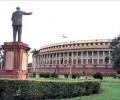
From 1952 to 1967, each of the three Lok Sabhas sat for an average of 600 days and more than 3,700 hours. In comparison, the 15th Lok Sabha -- from 2009 till 2013 -- has met for just 345 days and 1,331 hours, says Shreya Singh
'If unity is not going to be based on values and principles, how will we achieve it?'
 © 2026 Rediff.com - Advertise with us - Disclaimer - Privacy Policy - Sitemap - Feedback - About us - Terms of use - Grievances